
Search engine growth does not happen overnight. Rankings shift gradually, and website traffic usually grows in stages.
Because of that, clients need a clear way to see how their SEO campaign is progressing and what changes are happening along the way. Regular SEO reports help with that.
Without updates, the work behind SEO can feel invisible. A client may wonder what has changed, what is improving, and whether the strategy is working.
A good report answers those questions. It shows keyword movement, changes in organic traffic, and other signs that the site is gaining strength in search results.
Most agencies share reports once a month. Some also send weekly updates, especially when a campaign is very active or when a client wants closer tracking. Frequent reporting keeps everything open and easy to understand.
Reports also help clients see the return from their investment. When search traffic grows or new leads start coming from organic search, the numbers make the impact clear. In this blog, let’s explore everything about how an SEO company create client reports.
What is an SEO Client Report?
An SEO client report is a brief that shows how a website is performing in search results. Agencies prepare it to give clients a clear picture of what is happening with their SEO work.
Inside the report, you will usually find numbers related to organic traffic, keyword rankings, backlinks gained, and conversions coming from search.
It may also include technical performance, such as site errors or speed issues that can affect visibility. The purpose is not just to show data.
Clients also want to know what work was carried out during the reporting period. The report explains that. It also highlights the results that came from those efforts and outlines the next actions planned to improve performance further.
Why SEO Reporting Matters for Clients
SEO work does not always look obvious from the outside. Rankings change slowly, and much of the effort happens behind the scenes. Because of that, clients need a simple way to see what is going on. Regular reports make that possible. They show the progress, highlight the work being done, and help clients understand whether the campaign is moving in the right direction.
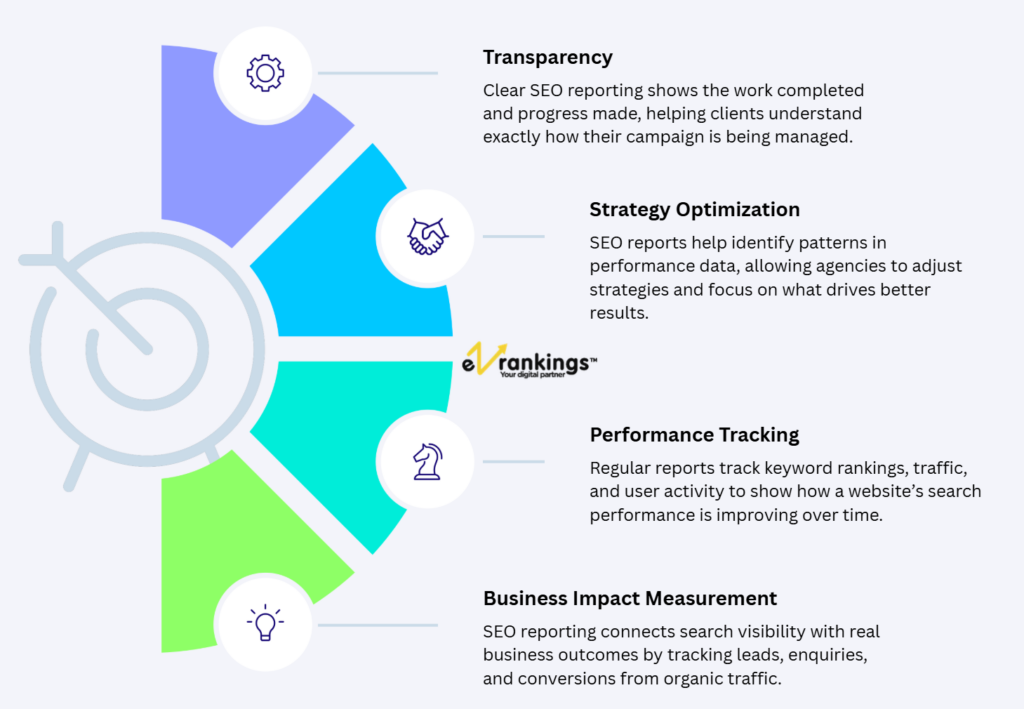
Transparency
Clients always want a clear picture of what their agency is doing. Clear reporting helps with that. When a report arrives, it shows the actions taken during that period.
Maybe new pages were created. Maybe technical problems on the site were fixed. Sometimes it is link building or updates to existing content.
All of that appears in the report. The client can see the effort laid out in plain terms. No hidden work. No confusion.
Over time, this kind of transparency builds trust. The client understands the process, and the agency does not have to keep explaining the same things again and again.
Performance Tracking
SEO moves gradually. One month a keyword sits on page three. A few weeks later it climbed closer to the top results. Traffic starts increasing little by little. Reports capture those small movements.
By looking at results each month, clients can follow the growth of their website. Traffic numbers, keyword positions, and user visits all start to form a clear picture. Some months show bigger jumps. Other months feel quieter. Both are normal.
What matters is the trend. Tracking the numbers regularly makes it easier to see whether the campaign is heading in the right direction.
Strategy Optimization
SEO never follows a fixed path. What works today may need adjustment tomorrow. That is where reporting becomes useful for the strategy itself.
When agencies study the data inside a report, patterns start to appear. Certain pages may attract more traffic than expected. Some keywords might struggle to move. A piece of content might suddenly bring new visitors.
Instead of guessing what to do next, the agency can adjust the plan using real data. Maybe more content is needed. Maybe internal links should be improved. Each report gives clues about where the effort should go next.
Business Impact Measurement
Ranking higher in search results feels good, but businesses care about something else. Revenue. Clients want to know whether SEO services are bringing enquiries, leads, or sales.
Reports help answer that question. When conversions from organic search start appearing in the data, the connection becomes clear.
Traffic alone does not tell the whole story. Leads and customer actions tell a much stronger one. In the long run, these figures show the role of search visibility in actual business expansion.
The value of work becomes much easier to notice when a client sees enquiries growing as a result of search traffic.
Key Metrics Included in an SEO Client Report
1. Organic Traffic Growth
The first number most clients look for is traffic. Put simply, how many people are finding the website through search.
A report usually shows sessions, total users, and page views. Those numbers give a quick picture of how active the site has become.
Some reports also break visitors into new users and returning users. That small detail tells an interesting story. New visitors show the reach of the site, while returning users hint that the content is worth coming back to.
Most agencies pull this data from Google Analytics and Google Search Console. Numbers alone can feel a bit incomplete, so reports often include a traffic graph. A simple line chart showing month-to-month growth makes the trend much easier to understand.
2. Keyword Ranking Performance
Keywords sit at the heart of SEO. After all, search visibility depends on where a page appears when someone types a query into Google.
Reports usually track how keyword positions are changing. Some keywords may climb steadily. Others might enter search results for the first time. Both are worth noting.
A list of best-performing keywords and the ones that are gaining momentum are often shown to the clients. Impressions and click through rate are also some of the data that help in explaining what is happening. A keyword can get impressions in thousands and clicks in few, meaning that the page title or description is possibly not doing well.
Over time, small ranking gains across many keywords start bringing noticeable traffic.
3. Conversion and Lead Metrics
Traffic feels encouraging, yet clients usually care about one thing more. Results. Professional SEO reports link the search traffic with actual business. It may be submissions of the forms, phone calls, purchase of products, or an inquiry form.
There is also some reporting that gives revenue generated on organic traffic. This section often becomes the most important one in the entire report. Why? Because it shows the impact beyond rankings.
A client does not just see visitors landing on the site. They see people taking action. When leads or sales begin to grow, the value of SEO becomes very clear.
4. Backlink Growth and Authority Metrics
Links from other websites still play a major role in search rankings. They are seen as signs of credibility by search engines. The snapshot of the link profile of the site is usually present in the SEO reports.
The agencies would keep track of the number of new backlinks that were accrued within a certain period. Such domains are referred to as referring domains.
Quality is more important than quantity. A good backlink by a reputable site may be stronger than a thousand weak links. Tools like Ahrefs, SEMrush, and Moz are used to collect this information.
Gradual increase in backlinks builds authority, which may help pages rank higher in search results.
5. Technical SEO Performance
Want results like this for your business?
Talk to our SEO & AI visibility experts — no forms, no waiting.
Get a Free ProposalBehind every website sits a technical layer that search engines need to understand. When problems appear there, rankings can suffer.
Reports often include checks for crawl errors, indexing issues, and other technical warnings that search engines report. Core Web Vitals also appear in many reports because they measure how fast pages load and how stable they feel when someone visits the site.
Page speed and mobile usability are also worth watching. A slow page can drive visitors away before they even read the content.
Agencies usually rely on tools like Google Search Console, Screaming Frog, and PageSpeed Insights to gather this information. Fixing technical issues keeps the site healthy and easier for search engines to read.
Competitor SEO Analysis in Client Reports
Numbers in an SEO report only tell part of the story. What really matters is how a website stacks up against the other players competing for the same searches. That is why agencies include competitor analysis in client reports.
A good starting point is keyword rankings. Platforms like SEMrush and Ahrefs show which search terms competitors appear for and how high they rank. Sometimes you discover rivals winning traffic from keywords the client has barely targeted. Other times the gap is small and easier to close than expected.
Traffic comparison is an important perspective. Tools like SimilarWeb can determine the amount of organic traffic on competitor websites and the channels that drive the visitors.
The largest opportunities can be noticed via the backlinks. Agencies will perform a backlink gap analysis to find sites that link to the competitors and not the client.
On-Page SEO Improvements Report
Clients often scroll straight to this part of the report. They want proof that real work happened during the month, not just numbers moving up or down.
Most reports start by outlining on-page optimization updates. That might mean adjusting headings, refining keyword placement, or fixing page structure so search engines can read the content more clearly. Small tweaks sometimes make a bigger impact than people expect.
Meta tag updates usually appear here as well. Titles and descriptions are rewritten to better match what people actually search for, which can help improve click rates from search results.
Internal linking work is another common update. Pages are interlinked more thoughtfully so visitors can move through the site without getting stuck.
Content optimization often completes the on-page work. Older pages get edited, updated, or cleaned up so they remain useful and competitive in search.
Content Performance Reporting
Content reports become more useful when you zoom in on individual pages. Instead of treating the website like one big block, agencies look closely at how each blog post or landing page performs.
Some pages naturally rise to the top. Reports highlight those top performing pages and the traffic they attract. It quickly shows which topics are pulling people in from search.
Engagement tells another part of the story. Time on page and bounce rate show the behavior of the visitors after they have arrived. Whenever individuals spend more time and visit more, the content is most likely to be doing its work.
SEO Reporting Tools Used by Agencies
1. Google Analytics
Most teams open Google Analytics first. It helps them see what happens after visitors land on the site.
Traffic numbers appear here, but the more useful signals are engagement related. Which pages hold attention. How long people stay. Where they leave. Those clues reveal whether SEO traffic is actually useful.
2. Google Search Console
Search Console tells a different story. It shows the way Google perceives the site. Agencies verify search impressions, clicks, and queries that cause a page to be shown in results. Here also indexing problems come up.
3. SEMrush
Keyword tracking usually happens inside SEMrush. Rankings move constantly, so agencies monitor those shifts and also look at which keywords competitors are targeting.
4. Ahrefs
Links carry a lot of weight in search. Ahrefs helps agencies keep track of new backlinks, lost links, and the overall strength of the link profile.
5. Looker Studio
Raw data can get messy. Looker Studio solves that problem. Agencies use it to pull information from different tools and turn it into clean dashboards that clients can quickly understand.
Common Mistakes in SEO Reporting
SEO reports sometimes look polished but still miss what the client actually needs to understand. Several pages appear in the document, yet the bigger picture remains unclear.
It can be thrilling to see keywords climb or fall in the search results, but it is not often enough to know how much actual progress is being made. Along with keywords, traffic, leads, and enquiries matter the most. In the absence of such a context, the numbers are empty.
Conversions get ignored more often than they should. A report might celebrate increased visitors while staying silent about whether those visitors take any meaningful action.
Clarity matters too. Reports overloaded with technical language will lose the reader halfway through. Clients should not need a glossary just to follow the update.
Good reporting keeps things practical. It explains what changed, compares performance with competitors, and points to the next steps so clients understand where the work is heading.
How Often Should SEO Reports Be Sent?
SEO reporting usually follows a simple rhythm. Too frequent, and the numbers barely change. Too slow, and clients feel left in the dark. Finding a balance matters.
Some agencies send weekly reports. These tend to be short updates. A quick look at ranking movements, traffic shifts, or small technical fixes completed during the week. Nothing heavy. Just a pulse check.
Most businesses rely on monthly reports instead. A full month gives enough time for real patterns to appear. Traffic trends become clearer. Keyword movement starts to make sense. The work done during the month can also be explained properly.
Then comes the quarterly review. That conversation usually zooms out. Bigger progress, strategy adjustments, and long term growth become easier to see here.
For most companies, monthly reporting with a quarterly review will work the best. It keeps everyone informed without drowning them in constant updates.
Future of SEO Reporting (AI and Automation)
SEO reporting is slowly moving away from static spreadsheets and long manual reports. Agencies now work with tools that process large amounts of data almost instantly. The shift is noticeable.
One change comes from AI driven reporting. Instead of listing numbers line by line, newer systems scan performance data and point out patterns that might otherwise go unnoticed. Sudden ranking drops. Traffic spikes. Unusual search trends. AI can flag them quickly.
Another idea gaining ground is predictive analytics. By looking at past search data, reporting tools can estimate where traffic or keyword visibility might head next.
Automation plays a big role as well. Automated dashboards now pull data from different platforms and organise it in one place.
Because the information updates continuously, businesses can see real time SEO data whenever they check the dashboard, rather than waiting for the next report.
Conclusion
SEO work can feel invisible without proper reporting. Rankings shift, traffic moves, content gets updated. But unless someone tracks the numbers carefully, it becomes hard to understand what is actually improving.
Strong SEO reporting changes that. It shows how search performance evolves over time and helps businesses see the real impact of optimisation efforts. When agencies review data regularly, they can adjust strategy quickly and focus on what brings results.
Clear reporting also builds confidence. Clients do not have to guess where their investment is going because the data tells the story. This is why transparent reporting is an important part of professional SEO packages, helping businesses track rankings, traffic growth, and conversions from organic search.
That is where a structured, data driven approach makes a difference. Our team at EZ Rankings- Best SEO Company India, focuses on transparent SEO reporting that shows measurable progress while guiding the next steps for sustainable search growth.

Mansi Rana
TEDx speaker and digital marketing expert with 22 years of experience driving business growth through innovation and strategy. Known for leadership rooted in both IQ and EQ, with a focus on ethical marketing and collaboration.
LinkedIn